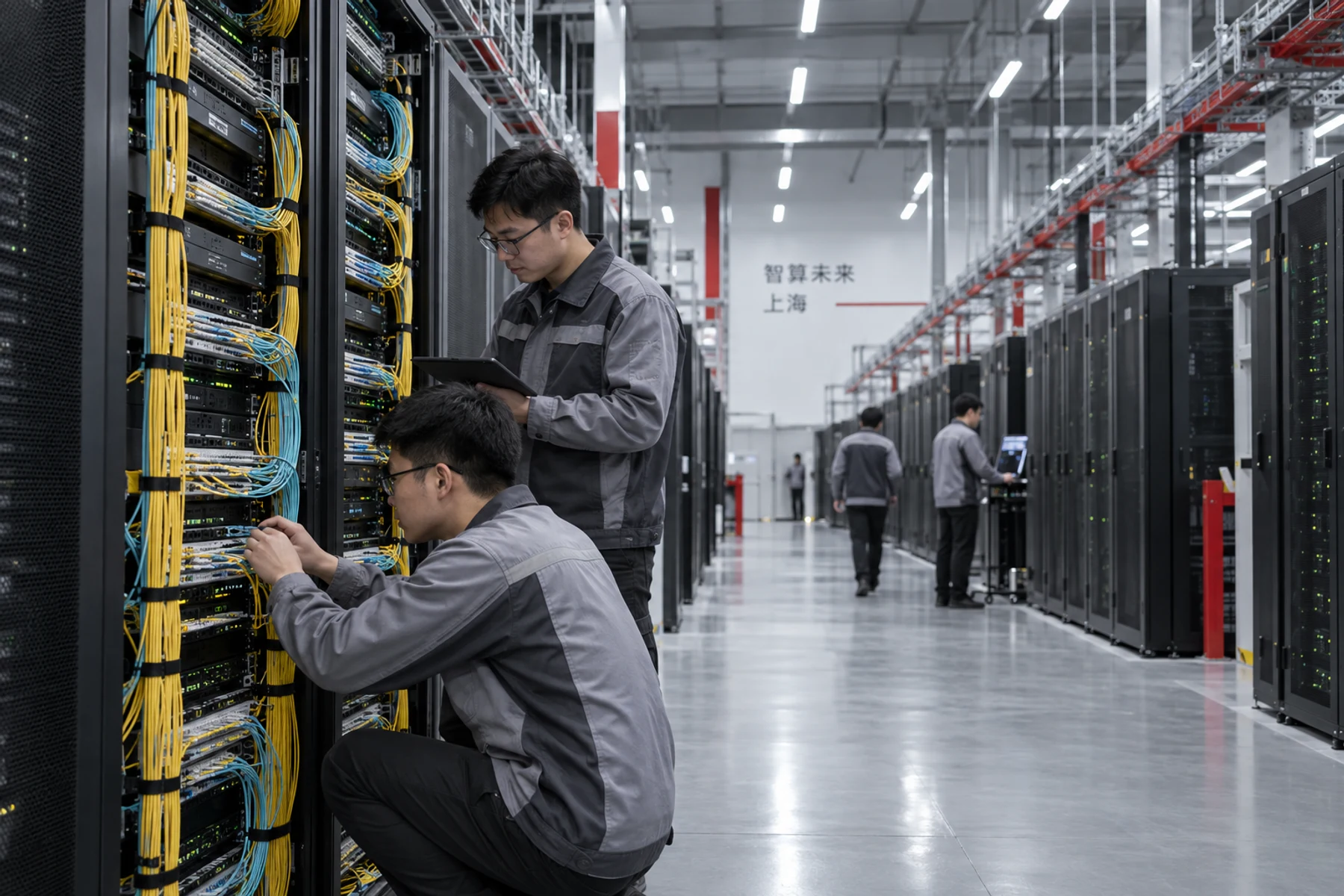
Huawei introduced the Atlas 960E SuperPoD as a system that can link 4,096 Ascend processors and target training or inference for very large models. The company describes it as the first SuperPoD based on network-packaged optics. That language is a product claim, not an independent benchmark, but it points to the real contest in AI infrastructure: interconnect efficiency, power and reliability at cluster scale.
Quick scan
In brief
Huawei says the Atlas 960E connects 4,096 NPUs and uses network-packaged optics.
The company positions the system for models with as many as ten trillion parameters.
No neutral, workload-level comparison was included in the launch material, so performance and efficiency claims remain to be independently tested.
Why the interconnect is the product
A large AI training job does not live on one processor. Work is divided across racks, and those processors exchange enormous amounts of data. When communication stalls, expensive silicon waits. Adding more chips can produce diminishing returns unless the fabric between them delivers bandwidth with predictable latency.
Network-packaged optics moves optical components closer to switching hardware. In theory, shorter electrical paths can reduce power and improve bandwidth density. In practice, optical packaging also introduces manufacturing, thermal and maintenance questions. The architecture is interesting because it acknowledges that a modern AI system is not just a chip specification; it is a coordinated facility.
Scale claims need workload evidence
A maximum processor count says little about useful output on its own. Buyers need to know how the system behaves with a real model, a real sequence length and a realistic mixture of computation and communication. Training throughput, inference latency, energy per token, fault recovery and software maturity can all change the result.
That is why independent benchmarking matters. Vendor announcements establish intended architecture, not operational economics. A cluster can be technically impressive and still be difficult to schedule, cool or repair. The key question is how much of its theoretical capacity remains available during long jobs.
Evidence map
What to separate
| Layer | Focus | What the evidence says |
|---|---|---|
| Signal | Why the interconnect is the product | A large AI training job does not live on one processor. |
| Constraint | Scale claims need workload evidence | A maximum processor count says little about useful output on its own. |
| Proof point | The geopolitical layer | Huawei’s launch also sits inside a wider effort to build advanced computing systems with constrained access to some leading foreign components. |
The geopolitical layer
Huawei’s launch also sits inside a wider effort to build advanced computing systems with constrained access to some leading foreign components. System-level engineering can compensate for limits in individual chips by using more devices and a fast fabric, but compensation is not free. It can demand more power, floor space and software work.
For customers, the practical issue is less about slogans of self-reliance than about supply, support and ecosystem risk. Hardware road maps, compiler compatibility and replacement parts can matter as much as peak throughput over the life of a system.
What to watch next
Look for audited power figures, sustained utilization on long training runs, failure recovery times and evidence from customers outside carefully controlled demonstrations. Those numbers will show whether the optical architecture is a durable platform or primarily an impressive scale statement.
The bigger trend is already clear: AI infrastructure competition is moving beyond who has the fastest accelerator. Networking, memory, cooling, scheduling software and serviceability are now part of the same product.