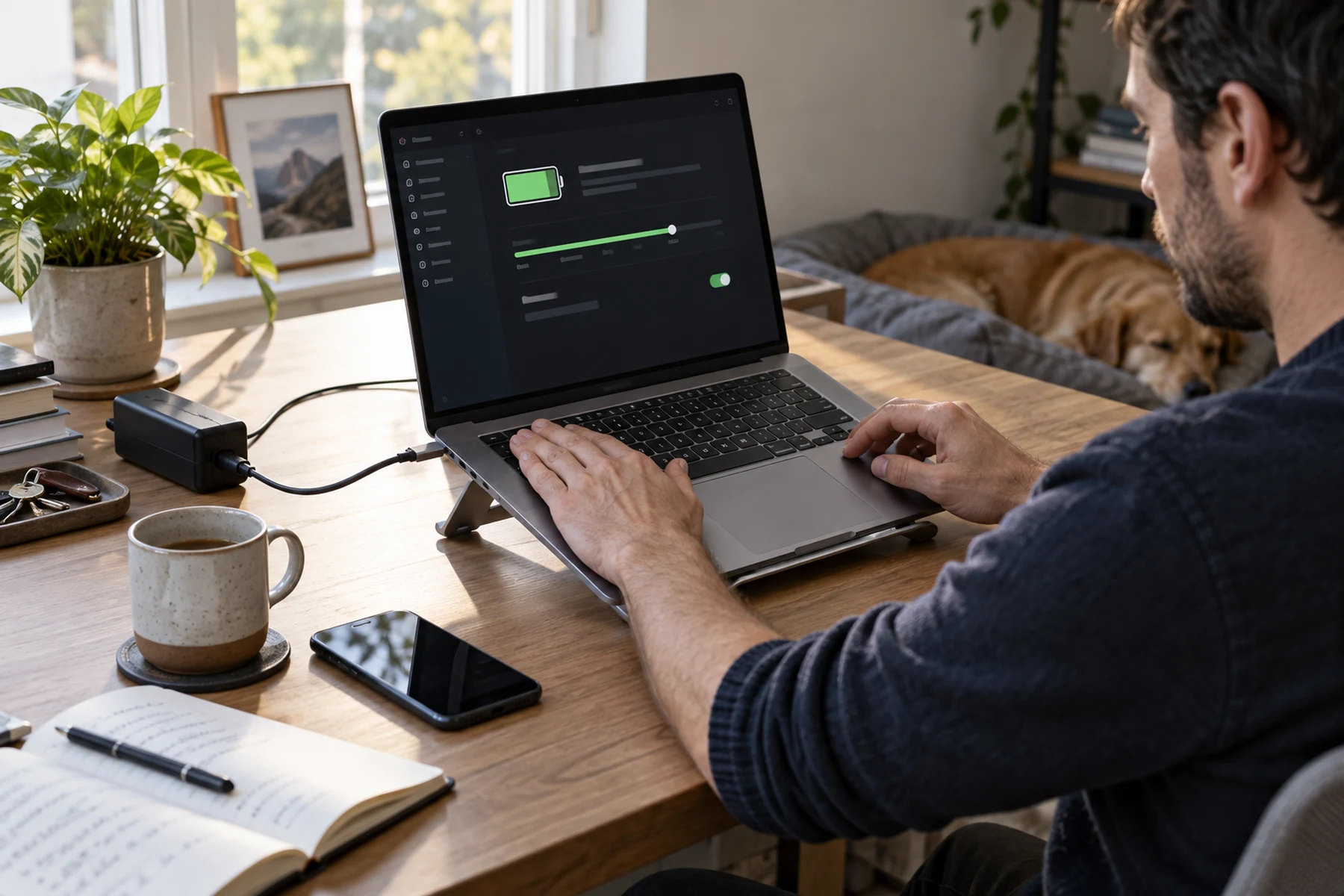
This guide addresses a recurring failure reported in user forums: running repeated zero-to-100 calibration cycles on a healthy battery. The safe method is staged and verifiable. It begins with an inventory, protects the last working path, follows current official documentation, and tests the result before cleanup.
Quick scan
In brief
Read the operating system battery report and the manufacturer diagnostic.
Reduce heat with clear vents, sensible power mode, and current firmware.
Back up data and stop using a swollen or overheating battery.
1. Read the operating system battery report and the manufacturer diagnostic
For “1. Read the operating system battery report and the manufacturer diagnostic,” follow the official path: Back up data and stop using a swollen or overheating battery. Match the service domain, device model, hardware revision, region, and ownership type before downloading software or changing security state. Forum advice can identify a symptom but cannot verify those identifiers for you.
The risk is blocking vents while plugged in at high load. Document the decision that permits the next action and the route back if it fails. On managed equipment, involve the administrator before clearing enrollment, encryption, or authentication records that may be controlled elsewhere.
2. Enable an 80-percent or conservation limit for long desk use when supported
Read the operating system battery report and the manufacturer diagnostic. Treat that instruction as an evidence step for preserve useful battery capacity while keeping the laptop available for the way it is actually used. A useful result states what was tested, from which account or network, and whether background synchronization, active sessions, metadata, or permissions also changed.
The reason for this discipline is running repeated zero-to-100 calibration cycles on a healthy battery. Review hidden state after the visible fix: recovery addresses, forwarding rules, OAuth grants, DNS, encryption, backups, and pending queues as relevant to “2. Enable an 80-percent or conservation limit for long desk use when supported.” Remove temporary access only after rollback is no longer needed.
Action map
What to do next
| Layer | Focus | Working instruction |
|---|---|---|
| Check | 1. Read the operating system battery report and the manufacturer diagnostic | For “1. |
| Action | 2. Enable an 80-percent or conservation limit for long desk use when supported | Read the operating system battery report and the manufacturer diagnostic. |
| Verify | 3. Reduce heat with clear vents, sensible power mode, and current firmware | A calm incident record begins with enable an 80-percent or conservation limit for long desk use when supported. |
3. Reduce heat with clear vents, sensible power mode, and current firmware
A calm incident record begins with enable an 80-percent or conservation limit for long desk use when supported. Tie it to “3. Reduce heat with clear vents, sensible power mode, and current firmware” and to the intended outcome: preserve useful battery capacity while keeping the laptop available for the way it is actually used. Avoid a chronological diary of every click; preserve the few observations that change the diagnosis or next action.
Name the avoided error—continuing to use a swollen pack or distorted case—and the point where specialist help becomes safer than another attempt. Store the summary away from the affected device. That makes the next response start with a tested method instead of an anxious memory.
4. Calibrate only when the displayed state of charge is clearly inaccurate and the maker recommends it
Finish “4. Calibrate only when the displayed state of charge is clearly inaccurate and the maker recommends it” by proving both normal use and recovery. Reduce heat with clear vents, sensible power mode, and current firmware. Then sign out, reboot where appropriate, and repeat the critical action with the old fallback still available. The aim is preserve useful battery capacity while keeping the laptop available for the way it is actually used under ordinary conditions, not a one-time success.
Do not close the incident while blocking vents while plugged in at high load remains possible. Confirm alerts, backups, ownership, and the location of recovery material. Delete exposed temporary copies, but retain the short non-secret record that explains the verified route and its stop conditions.
5. Back up data and stop using a swollen or overheating battery
Calibrate only when the displayed state of charge is clearly inaccurate and the maker recommends it. This action advances the goal to preserve useful battery capacity while keeping the laptop available for the way it is actually used. It also addresses the concrete failure mode “running repeated zero-to-100 calibration cycles on a healthy battery.” Capture the starting state and keep the last working device, session, or copy available until the new path has passed an independent test.
For “5. Back up data and stop using a swollen or overheating battery,” verify the result from a fresh session or second device. Note the exact screen, version, owner, and time without copying secrets. If the result cannot be repeated, return to the preserved state rather than stacking another irreversible change on top.
Protect the recovery route for preserve useful battery capacity while keeping the laptop available for the way it is actually used
The next move is specific: Back up data and stop using a swollen or overheating battery. Do it before any reset, deletion, migration, or firmware change connected with preserve useful battery capacity while keeping the laptop available for the way it is actually used. The mistake to prevent is continuing to use a swollen pack or distorted case; a screenshot of success is not enough if the recovery channel has never been tested.
Use “Protect the recovery route for preserve useful battery capacity while keeping the laptop available for the way it is actually used” as a checkpoint. Confirm the account or hardware identity, test one representative action, and record both the successful and failed behavior. Keep recovery codes, keys, or exports outside the affected device and never paste them into a search box or support chat.
A dry run for running repeated zero-to-100 calibration cycles on a healthy battery
Start this stage with read the operating system battery report and the manufacturer diagnostic. The purpose is preserve useful battery capacity while keeping the laptop available for the way it is actually used, not merely reaching the next screen. Because blocking vents while plugged in at high load, change one variable and observe the exact function that was failing before continuing.
Under “A dry run for running repeated zero-to-100 calibration cycles on a healthy battery,” include a stop condition: loss of the only copy, an unmatched key identifier, unstable power during a write, an unknown administrator, or instructions for a different model. Preserve evidence and escalate at that boundary instead of improvising.
What to preserve before cleanup
A reversible workflow makes preserve useful battery capacity while keeping the laptop available for the way it is actually used easier to verify. Enable an 80-percent or conservation limit for long desk use when supported. Label any export with date and device, separate it from the live system, and make sure its location does not depend on the account currently being repaired.
The scenario behind “What to preserve before cleanup” is running repeated zero-to-100 calibration cycles on a healthy battery. Test the safer alternative on one account, file, or endpoint first. When it works, repeat the check after a restart or clean sign-in so cached state does not create a false pass.
How to verify the final state
For “How to verify the final state,” follow the official path: Reduce heat with clear vents, sensible power mode, and current firmware. Match the service domain, device model, hardware revision, region, and ownership type before downloading software or changing security state. Forum advice can identify a symptom but cannot verify those identifiers for you.
The risk is continuing to use a swollen pack or distorted case. Document the decision that permits the next action and the route back if it fails. On managed equipment, involve the administrator before clearing enrollment, encryption, or authentication records that may be controlled elsewhere.
When to stop and escalate
Calibrate only when the displayed state of charge is clearly inaccurate and the maker recommends it. Treat that instruction as an evidence step for preserve useful battery capacity while keeping the laptop available for the way it is actually used. A useful result states what was tested, from which account or network, and whether background synchronization, active sessions, metadata, or permissions also changed.
The reason for this discipline is blocking vents while plugged in at high load. Review hidden state after the visible fix: recovery addresses, forwarding rules, OAuth grants, DNS, encryption, backups, and pending queues as relevant to “When to stop and escalate.” Remove temporary access only after rollback is no longer needed.
A two-minute record for the next incident
A calm incident record begins with back up data and stop using a swollen or overheating battery. Tie it to “A two-minute record for the next incident” and to the intended outcome: preserve useful battery capacity while keeping the laptop available for the way it is actually used. Avoid a chronological diary of every click; preserve the few observations that change the diagnosis or next action.
Name the avoided error—running repeated zero-to-100 calibration cycles on a healthy battery—and the point where specialist help becomes safer than another attempt. Store the summary away from the affected device. That makes the next response start with a tested method instead of an anxious memory.
The final recovery rehearsal
Finish “The final recovery rehearsal” by proving both normal use and recovery. Read the operating system battery report and the manufacturer diagnostic. Then sign out, reboot where appropriate, and repeat the critical action with the old fallback still available. The aim is preserve useful battery capacity while keeping the laptop available for the way it is actually used under ordinary conditions, not a one-time success.
Do not close the incident while continuing to use a swollen pack or distorted case remains possible. Confirm alerts, backups, ownership, and the location of recovery material. Delete exposed temporary copies, but retain the short non-secret record that explains the verified route and its stop conditions.